Tech Journal How Automation Can Bring ‘Death to Busy Work’ and Empower Teams to Accomplish the Impossible
For businesses striving to reduce costs, increase employee satisfaction or optimize operations, automation needs to be a business priority.
By Tech Journal / 15 Nov 2022 / Topics: Artificial Intelligence (AI) , Modern workplace , Featured , Digital transformation

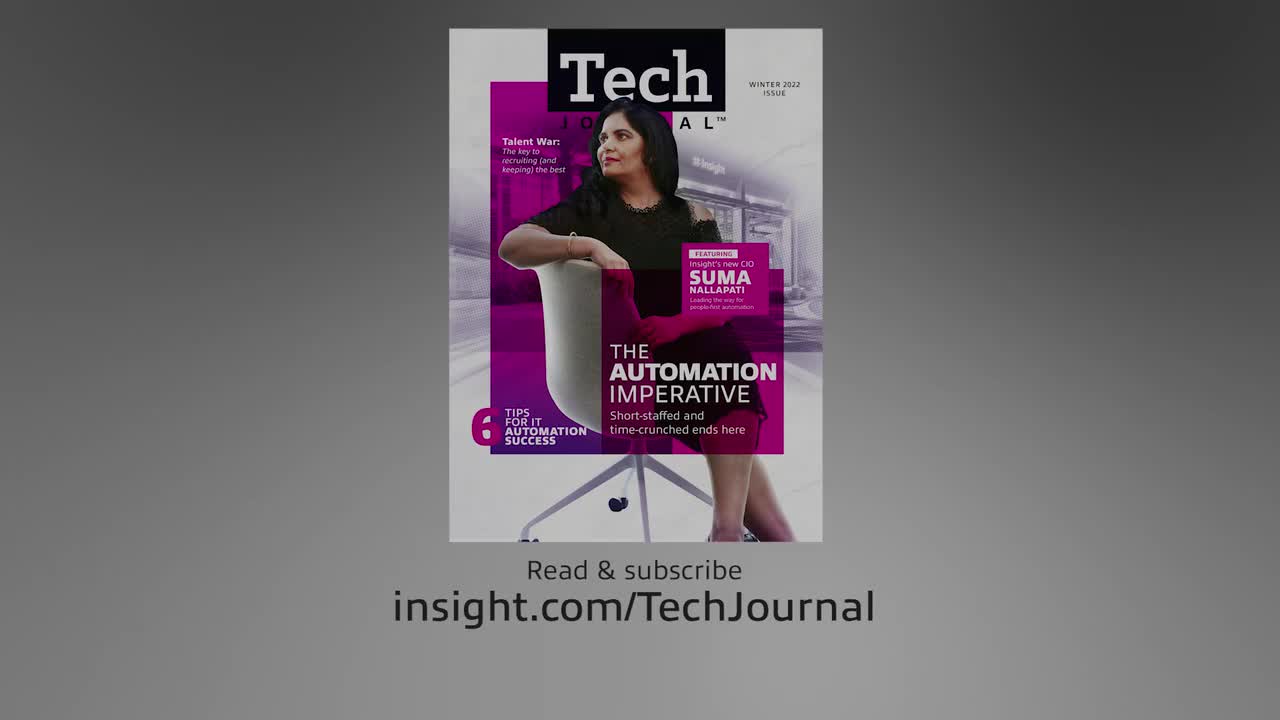
Throughout her career, Chief Information Officer Suma Nallapati has put people first while spearheading transformational IT initiatives. Now, she’s helping Insight’s teams and clients do the same when it comes to automation.
Business leaders have always had to manage complex challenges at all once — improving operational efficiency, elevating the customer experience, increasing ROI and much more.
Today, they must confront these challenges in a constantly changing business environment — and many of them are doing so with constrained budgets and a reduced workforce. In an era of unprecedented turnover, organizations are under intense pressure to offer optimal employee experiences that support autonomy, fulfillment and well-being.
While there's no silver bullet for tackling today’s business challenges, automation offers a compelling intervention. Applied thoughtfully and through a people-first lens, it packs a powerful punch to boost operational excellence and employee satisfaction.
Understandably, many people are skeptical of automation in the workplace and wonder, could automation replace jobs? But approaching automation from a human-centric perspective ensures these technologies will enhance, not replace, human work. Done right, it removes the burden of completing mundane, repetitive tasks, so employees can concentrate on value-add activities that promote business growth and make their work more meaningful.
To take a human-centric approach to automation, business and IT leaders must understand its relationship to human intelligence. Then, they can apply that knowledge to crafting a people-first strategy to implement automated processes and workflows that support their business needs, goals and culture.
At Insight, CIO Suma Nallapati is doing just that. Tasked with leading the company’s hyper automation strategy, Suma is showing Insight’s internal teams and customers the power of automation for today’s workplaces and workers.
“It will help give more value-centric work to humans and take away the mundane within our workflows. It’s a balance between what we do as humans and what machines can do, so we create the most effective user experiences for our customers, clients, patients and citizens.
How humans and automated technologies work hand in hand
While it comes in many forms, automation broadly refers to a set of technologies and interventions that take over manual, repetitive tasks and processes to reduce the cognitive load on human beings and improve the efficiency and accuracy of business operations.
And Suma sees “human beings” as the operative words. Even as she praises the valuable outcomes automation can drive, she emphasizes that these technologies will never be able to replace what human employees bring to the table.
“Automation is about augmenting or supplementing human intelligence,” Suma says. “It will help give more value-centric work to humans and take away the mundane within our workflows. It’s a balance between what we do as humans and what machines can do, so we create the most effective user experiences for our customers, clients, patients and citizens.”
Throughout her career, Suma has witnessed the profound impact automation can have on employees, organizations — and the people they serve.
When she was CIO for the State of Colorado, Suma observed that analog, manual processes impeded the eligibility verification process for residents seeking life-saving support like Medicare, Medicaid and food stamps. Suma and her team introduced cloud-based automated technologies, such as bots, to make the process more efficient. In the end, they were able to reduce the eligibility verification process from weeks and months to days and, in some instances, minutes.
This project holds a special place in Suma’s heart: “The effort enabled us to literally put food on people’s tables. I’m very proud of the work because you have a direct impact on the most vulnerable populations. That’s the power of technology and the power of automation.”
“The effort enabled us to literally put food on people’s tables. I’m very proud of the work because you have a direct impact on the most vulnerable populations. That’s the power of technology and the power of automation.

By automating internal workflows, better customer experiences follow suit.
In her current role as CIO, Suma leads Insight’s hyper automation strategy. The company’s highly innovative, creative and people-centric culture makes its investment in automation a no-brainer as far as Suma is concerned. And she wants to leverage that mindset to create a center of automation enablement that fosters capabilities and foundational excellence for Insight to apply to client-facing workloads.
To progress toward this goal, Suma and her team took a people-first approach to understand what their own business partners and internal stakeholders need from automation. They embarked on a listening tour and conducted in-depth interviews to uncover how automation could most benefit their colleagues. From there, her team began looking at which processes and technologies they could implement to improve Insight’s internal workflows.
Understanding automation in the workplace
In today’s intelligent, efficient, data-driven era, key concepts such as intelligent business automation, business process automation and workflow automation are driving change.
By starting with the end users and their pain points, Suma and her team ensured their solutions would be truly human-centric and could deliver the right operational improvements for their coworkers’ specific needs.
At the end of the day, Suma sees Insight’s efforts at automation for employees and clients as deeply intertwined.
“As an IT organization, we want to build capabilities that are both internal- and external-facing,” says Suma. “Pursuing internal automation initiatives not only improves Insight’s operations, but it also strengthens our expertise. In turn, shepherding automation for our clients deepens our learnings and helps us iterate and improve our internal processes, benefitting our clients once again.”
Avoid automation for its own sake.
Whether Suma and Insight are concentrating on their internal or external clients, their efforts are squarely focused on end-user pain points and the people at the center of the work.
And Suma recommends a similar approach for organizations trying to develop and implement an automation strategy. She firmly believes that business shouldn’t “automate for automation’s sake.”
Suma advises, “You should take a good, long look at your existing business processes to identify your end users’ primary challenges, such as the errors that occur most often or the ‘busy work’ that eats up employees’ time. Then, you can begin designing and implementing the right automated technologies and solutions.”
Suma knows firsthand the transformative effect of customizing automation for specific end users. While serving at a telecommunications company, she learned the finance and accounting teams were putting in long hours — sometimes overnight — to complete their month-end close. They were also missing their kids’ school and sporting events, sacrificing other after-work commitments and accumulating a great deal of stress in the process.
With employee resentment and burnout looming, it was a complex problem in need of a solution.
Suma and her IT professionals collaborated with the finance team to figure out which processes were taking up the most time. Together, they determined how to incorporate automation into their workflows and ultimately trimmed days from the close cycle.
The finance team was so grateful to have their personal time restored, they threw a huge party for IT to celebrate the win.
In this case, automation achieved the impossible: creating the gift of time.
This story reveals the true ROI of automated technologies and illustrates a point Suma can’t emphasize enough: Automation is everyone’s responsibility.
Suma encourages business and IT leaders to empower all employees to contribute to automation efforts. “Raise a hand if something is inefficient or error-prone,” she advises. Organizations can benefit from framing these initiatives as a CICD — continuous improvement and continuous delivery of capabilities — to which every employee can contribute.
Using Insight as an example, Suma explains, “We all need to be thinking about the next opportunity within our systems because it’s our responsibility to be automation-centric and client-obsessed.” Under Suma’s leadership, Insight is guiding its internal teams to embrace the human side of automation to elevate the outcomes for clients and their end users.
“We all need to be thinking about the next opportunity within our systems because it’s our responsibility to be automation-centric and client-obsessed.
Looking to the future
Automation informed by a human-first perspective has a pivotal role to play in helping organizations navigate the business landscape today and tomorrow. With employees free to concentrate on strategic initiatives, innovation and other value-centric efforts, organizations can build the agility, flexibility and resilience they need to thrive in periods of uncertainty — and to embrace new opportunities.
There’s no doubt that automation has a bright future. “Automation is taking on new realms every single day as we find more efficiencies within the bots’ capabilities and the machines learn so much more,” says Suma.
But even as automated technologies advance and new use cases emerge, one thing will likely remain the same: Humans will continue to reap the benefits. As Suma says, “The power of automation is to move things along so we can spend that additional time on truly valuable workloads that appeal to our senses and to our soul — the meaningful work that drives us.”
About the contributor:

Suma Nallapati
Chief Information Officer (2022–2023), Insight
Suma Nallapati served as Insight's chief information officer from April 2022 to July 2023. During this time she drove Insight’s digital transformation efforts, including enhancing client experiences, expanding data and digital capabilities, and overseeing day-to-day IT operations and cybersecurity.



Advertisement




Advertisement

Related articles




Narrow your topic:
Artificial Intelligence (AI) Digital transformation Tech Journal View all focus areas

About Tech Journal
Tech Journal is a free, quarterly digital magazine written by IT pros, for IT pros. It incorporates thought leadership on a range of topics, including supply chain optimization, workplace collaboration, cloud and data center transformation, and digital innovation. Dive into the trends and solutions shaping today’s IT and business landscape and hear best practices firsthand from the experts themselves.
Learn more about how Insight can help you manage today's needs and prepare for the future.