Blog Focusing on the 5 Elements of User Experience
“User Experience" (UX) has become a buzzword when it comes to all things digital. “Good UX” is used to describe anything with an interface or to validate decisions made in a vacuum. Organizations want it. Users crave it. But no one can explain what makes it “good.”
By Adam Deardurff / 24 Feb 2017 15 Oct 2019 / Topics: Application development , Customer experience

UX has many layers.
In 2000, Jesse James Garrett created a simple diagram to visualize the core components and dimensions that create a positive experience with his “The Elements of User Experience” model.
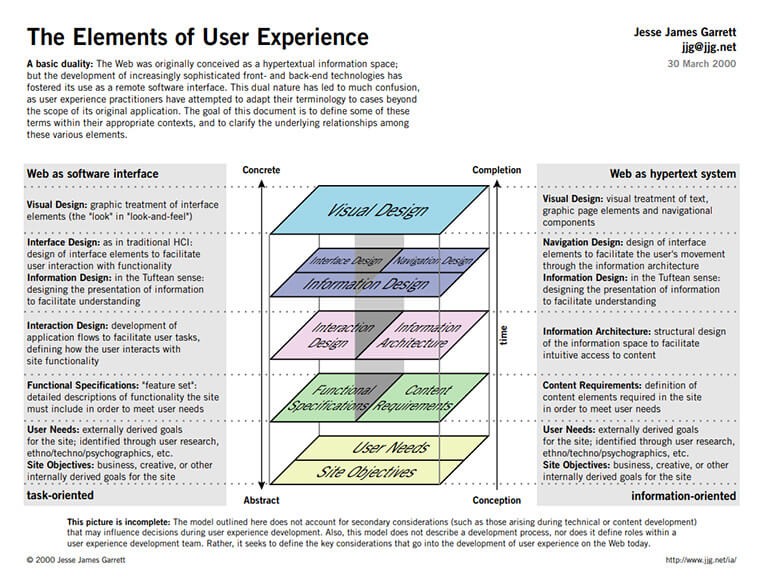
Starting from the bottom of the chart, these elements of user experience can be summarized as:
- Strategy — this is where you define objectives you want to meet with your project.
- Scope — where you define all the features you'll include in detail.
- Structure — is when you're defining how users navigate through the experience.
- Skeleton — which is your first design of navigation and functional elements
- Surface — finally, this is the finished product, putting it all together
And, for the most part, these concepts still hold true today. Projects get messy when trying to effectively apply these elements and meet critical business objectives. Let's explore how you can use these elements to focus on the user and implement the right foundations of user experience design.
Focus on the foundation.
When you think about UX, it can be tempting to either quickly skip to the upper “design layers” of the model or focus on a feature-centered approach. However, like any structure, the most important layer is the foundation. The foundation of a good UX should be made up of site or business objectives and user needs. What the model implies — but may not clearly depict — is the importance of staying focused on these objectives and needs as each layer of the experience takes shape.
Uncover the business-centered approach.
Site objectives are often either driven by the client, buried in requirements or extracted through a series of stakeholder interviews, design thinking sessions and surveys. Identifying the right stakeholders can be a challenge and may require many different touchpoints. But, involving the business at each step of the process is integral to success. Whether it's at the end of development cycles, sprint reviews or at any other stage in the process, an inclusive approach and ongoing transparency ensure that site or product objectives are being maintained throughout.
The most important piece of information to extract is a tangible Key Performance Indicator (KPI). What’s the problem being solved? What are the desired outcomes and business value being delivering? Do benchmarks exist? Without a firm understanding and agreement on what success means, the team responsible for crafting the experience cannot hold itself accountable for the performance or quality of the experience.
It’s easy to be reactive and plan around site objectives that are dictated by individuals or internal politics, but the team must remember this is only one half of the foundation. What makes or breaks a user experience is the understanding of the actual user needs associated with the business problem — and the ability to apply them throughout the development process.
Put user needs first.
In his “Elements of User Experience” model, Garrett describes user needs as the externally derived goals for the site, identified through user research.

The keyword here is external. Creating a true user-centered experience requires an unbiased third-party perspective working to understand, not just the needs, but the thoughts and feelings that drive behavior, decision-making and satisfaction. A trusted partner will have the ability to conduct and extract all types of qualitative and quantitative data that, when aggregated, can paint a holistic picture of a user’s needs. Sources and activities include, but are not limited to:
Primary research
- Analytics and proprietary data
- User/usability testing
- Focus groups
- On-site observations or session recordings
- Online or email surveys
Secondary research
- Search data
- Third-party studies
- Paid reports
- Industry and competitive audits
- Social audit
This list of tools and activities can provide valuable insights, not only into users’ digital needs, but also the educational and emotional barriers that may get in the way of understanding the end user experience.
Of all the possible inputs, it’s arguably most important to include at least one observation activity. This is the only way to truly understand why a product impediment impacts users. But, this is not a one-time obligation, limited to the beginning of our process. Instead, it’s an ongoing and integral part of UX design.
Crafting a successful UX
The UX team also needs to involve external users throughout the process in order to understand quality and validate decisions. From navigation taxonomies to content design, getting users’ feedback along the way will help drive optimal product delivery.
There are many ways to solicit feedback before or during development using methods like card sorting, tree testing, usability testing and focus groups. Through observations of user interactions, you can more clearly see where your solutions meet user needs and where further optimizations need to be made.
Success is user dependent.
Steve Jobs said, “You’ve got to start with the customer experience and work back toward technology — not the other way around.”
There are many tools and touchpoints worth considering throughout the product development process. Users are complex and don’t always respond to new technologies or progressive interfaces. Testing products can mean the difference between creating something users love or something they hate.
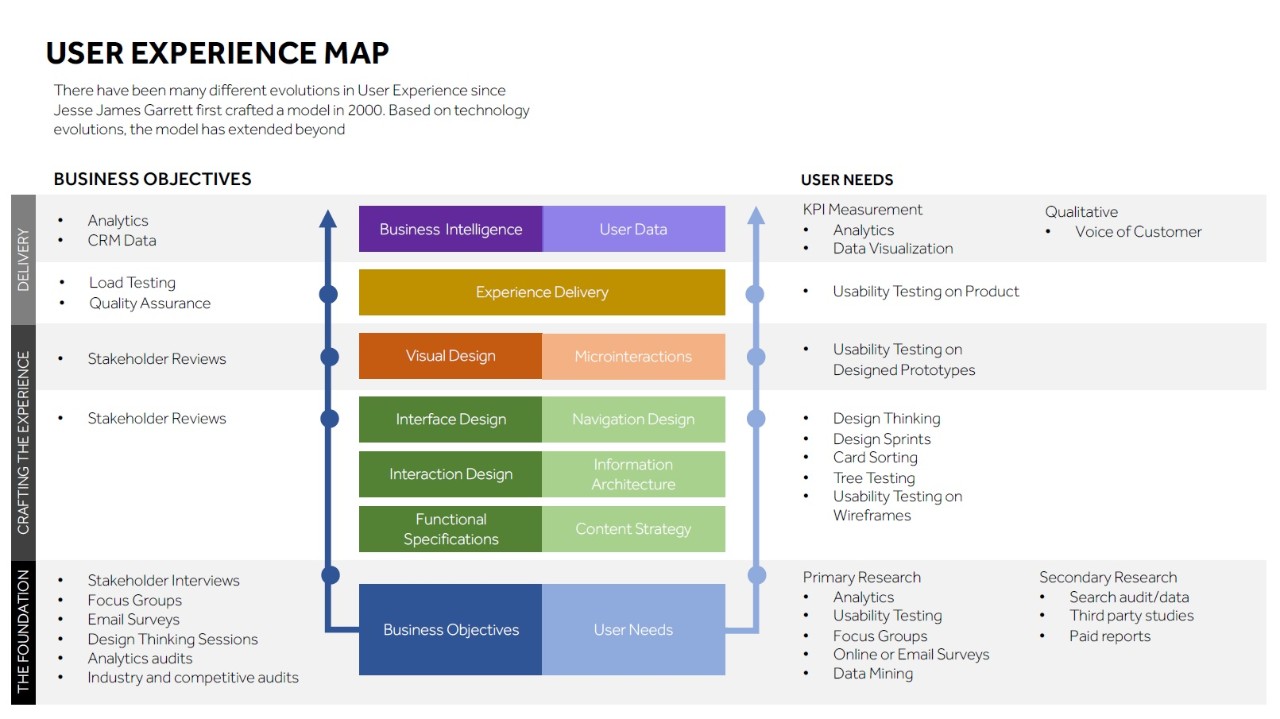
To visualize the focus necessary throughout this process, an updated user experience map might look something like this:
Final thoughts
It’s easy to get caught up in the requirements and complex systems that go into delivering an optimal experience. If you don’t initially understand and focus on the foundation of creating user value, you risk alienating our user base, creating a product without value or having to start the process all over again.
Measuring a good user experience isn’t just about KPIs, it’s about engaging your users in an ongoing conversation. Whether you're already maintaining a quality user experience or undertaking an enterprise-wide digital transformation, the job is never finished. It requires constant communication and feedback loops to ensure you deliver on your business or product objectives — and your users’ ever-changing needs.

Adam Deardurff
Sr. Manager, Microsoft Partner Strategy, Insight
Adam leads digital strategy and design transformations of organizations, experiences and products. His roots in business, research and analytics serve as a foundation for understanding and applying insights to user experience practices.
 Monthly perspectives from global tech leaders.