Blog How to Foster Motivation and Purpose Through Agility
“We want to be more agile in our delivery.” “We need to build up our teams.” “How can we do Scrum well?” Companies are asking themselves these questions every day and looking in various places for the answers.
By Chris Conlin / 2 Mar 2017 21 Aug 2019 / Topics: Application development , Modern workplace

Instead of looking at processes, checklists or specific methodologies, let’s talk about what organizations and teams are made of: people. If we want to have great organizations, we need to have thriving teams. In order to have thriving teams, we need to have motivated individuals.
How do we even begin to find, develop and retain motivated individuals? The good news is, agility has mechanisms, mindsets and ideals already built in to motivate team members and give them purpose in their everyday work.
So, I know what you’re thinking: Oh great, another millennial writing a blog post about motivation. And you're exactly right. You might want to get used to it.
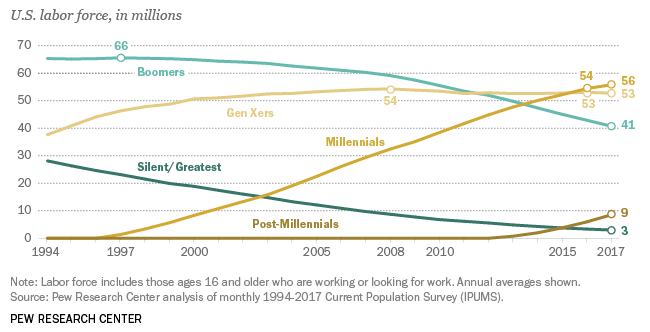
We all know the stats: More than one-in-three members of the American workforce (35%) are now millennials, making them the largest portion in the U.S. labor force, according to Pew Research Center. And that percentage will only continue to rise in the next few years.
The value of meaningful work
We millennials are infamous for wanting to have purpose in our jobs. (I would argue that most generations want the same but aren't as vocal about it.) We’re not a generation that wants to come into the workplace, punch in, do our jobs and then punch out.
The workforce as a whole is evolving, people want meaningful work that integrates easily with the rest of their daily lives. Unfortunately, most organizations don't provide this opportunity. According to the Deloitte Global Millennial Survey 2019, more millennials than ever — 49% — would, if they had a choice, quit their current jobs in the next two years.
This decision is often motivated by more than just money. While more than half of millennials want to earn higher salaries, the ability to travel and see the world tops the list of millennial aspirations, closely followed by the desire to make a positive impact in their community.
If your organization isn't adapting to the evolving employee landscape, you risk your top talent eventually becoming burned out and leaving for an organization that's able to motivate its employees — or even leaving to start their own company. In fact, according to an Inc. article, 66% of millennials have goals to start their own business. Why is this, and how do we address it?
Employee motivation matters
Before we dive in any further, let’s define our terms. When I say motivation, I define it as finding meaning in your job (how YOU make a difference to the whole). Consider the following quote:
“If you want to build a ship, don’t drum up people to collect wood and don’t assign them tasks and work, but rather teach them to long for the endless immensity of the sea.”
— Antoine de Saint-Exupery
People want to work for something more than just a paycheck. They want to find meaning. A 2018 survey from Harvard Business Review reveals that more than nine out of 10 employees would be willing to trade a percentage of their lifetime earnings for greater meaning at work. Employees who find work highly meaningful are 69% less likely to plan on quitting their jobs within the next six months, and on average, have job tenures 7.4 months longer than those who lack meaning.
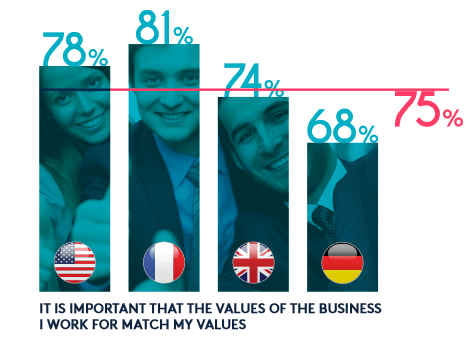
For millennials, this desire for greater purpose extends to a company’s mission overall. A global study from American Express reports an average of 62% of millennial workers want to be known for making a positive difference in the world, and 75% say it’s important for the values of the company they work for to match their personal values.
As employees and consumers, we tend to patronize and support organizations that demonstrate a purpose beyond making money. Many millennials won’t hesitate to lessen or end a relationship with a business when we disagree with a company’s practices, values or political leanings.
Strong teams start with a strong purpose
So what can you as an organization do about this? How do you provide this for your people so that they'll love what they do — and help make excellent products for your customers?
Instill a sense of purpose.
Merriam-Webster defines purpose as “the reason for which something is done or created, or for which something exists.” In his book, “Drive,” Daniel Pink talks about what makes a motivated employee, and he boils it down to three things:
- Autonomy — the art of self-organization and having some semblance of control over your surroundings
- Mastery — the ability to do something well
- Purpose — being connected to something larger than yourself
At some point, people would rather be happy than make more money. In creative work (which would apply to software development), studies have found that after a certain point, money is a demotivator. So why do we still use it as the motivator?
Happiness and flexibility are becoming increasingly important to modern employees. One of the most famous, time-tested illustrations of this concept comes from Maslow’s Hierarchy of Needs, which also applies to individuals on teams within organizations.
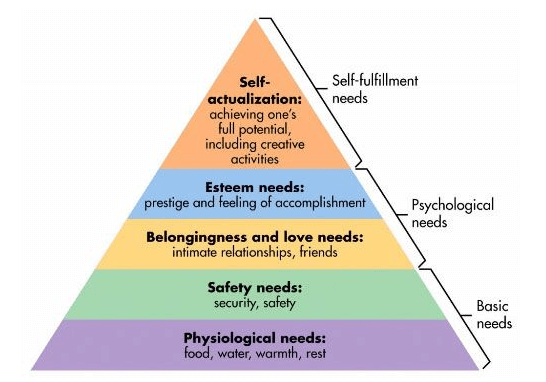
Maslow argues that after base financial and security needs are met, our desires move upstream to purpose and self-actualization. He also argues that communities are becoming increasingly important — people need other people, shown as the psychological needs in the pyramid. By having strong teams, this can become a reality.
Fostering agility with purpose
So how does this apply to Agile? Through agility — not specifically Scrum, Windows XP or SAFe (although there are a lot of processes in place in these that build opportunities in) — but through broader business agility, organizations can make sure the needs of their employees are met.
Modern Agile paints a great a picture of what this looks like:
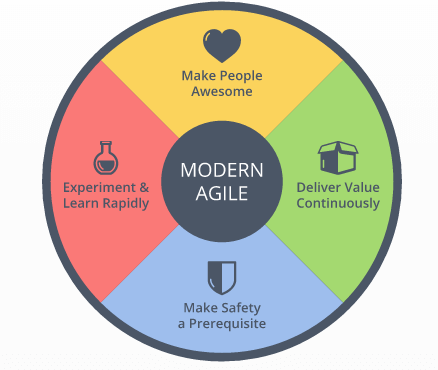
When agility is done correctly, all of these components come together to create an environment where purpose and motivation can thrive.
When Agile values are implemented, employees are able to determine their purpose. Traditional purpose methods are based on finding overlap in a few key areas, as shown below:
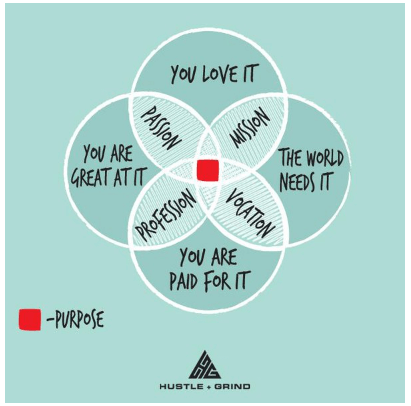
I would argue that this has a flawed premise. It assumes people know all of these areas. Through agility, we make the unknown known through experimentation and response to change. Jurgen Appelo, creator of Management 3.0, says it best:
“The Venn diagram of purpose is both right and wrong. It is right because purpose is the result of a lot of work that you need to do in four different areas. However, it is wrong in making people believe that purpose is something for you to discover, as if it is already there, hiding somewhere in those four overlapping areas. For some of you, that might even be true. But for most of us, purpose is something that we create.
We explore things until we love them;
We invent things until we get paid;
We change until the world needs us;
And we practice until we're good at it.
Purpose is something to be created, with a lot of hard work.”
So, what does agility with purpose mean for a software development organization?
- Stop focusing so much on money, raises and financial benefits. These are necessary to a point, but they have a quickly diminishing return after that point. Instead, switch the focus to providing a positive environment that helps people grow and meet their goals beyond the financial realm.
- Experiment. Keep building products your customers will love. By doing this, you allow team members to be close to the problem — and the solution. The ability to see how they’re improving the lives of others will help improve motivation, regardless of the specific domain your company is in.
- Respond to change. Allow your teams to own their work and their destiny. Teach them about your company goals and explain why those goals are important, while providing the freedom to create within that space. Although there may be short-term pains and some discomfort along the journey, doing so will create long-term gains that will help your organization adapt and thrive.

Chris Conlin
Former Product Owner Coach, Insight
Chris believes in bringing the human focus back to organizations. In his career, Chris has served in a wide variety of roles, ranging from product management and Agile coaching to business analysis — and just about everything in between. He sees agility as an excellent tool for using these roles to help instill a sense of purpose, leading to happier employees, customers and organizations.
 Monthly perspectives from global tech leaders.