Article 3 IaaS Cloud Computing Trends to Watch
What is cloud computing? Cloud computing is a broad term that applies to a range of services — servers, storage, databases, networking, software, analytics and more — that are provided via the internet.
By Isabel Ticlo / 14 Feb 2017 / Topics: Artificial Intelligence (AI) , As a service , Cloud

The term may seem daunting or vague, but in reality you probably already use cloud computing services on a regular basis.
Suppose you’re working on a major video project that requires collaboration across your marketing team. Since you’re located off-site, you create a Google document to draft a script that your co-workers can keep and edit in realtime. Once you’re satisfied with the format, you save the final copy and email it to the rest of the department.
After a few days of filming and editing, your production team uploads the finished product to your company’s social networking sites, where it can be shared and viewed time and time again. Congratulations! You have successfully completed your video project using cloud computing every step of the way — from editing your documents and sending emails to storing files and streaming content.
Cloud computing continues to reach new heights.
Most cloud computing services fall into three broad categories:
- Software as a Service (SaaS): A method for delivering software applications on demand and online
- Platform as a Service (PaaS): An environment in which you can develop, deliver and manage software applications on demand and online. PaaS includes both infrastructure — network, storage and compute — and middleware — development tools, operating system and database.
- Infrastructure as a Service (IaaS): An opportunity to rent infrastructure hardware such as servers and storage on demand and online
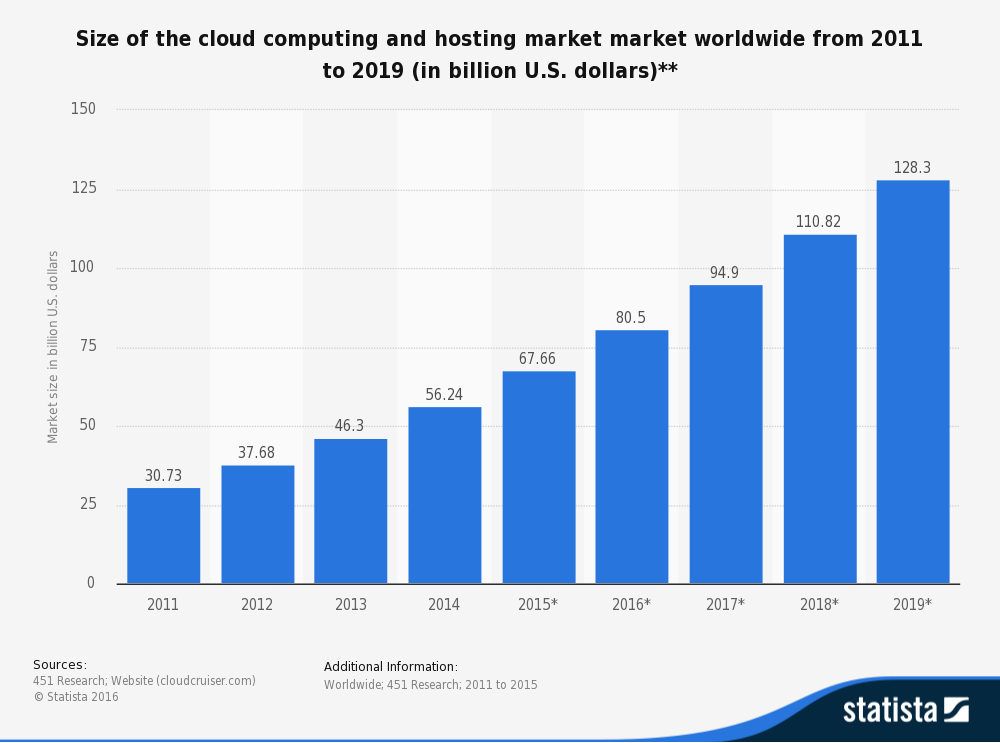
Over time, more businesses have adopted cloud practices to reduce costs, increase speed and productivity, and scale with an unrestricted, global reach. As depicted in Figure 1, the size of the cloud computing market worldwide is expected to reach $128.3 billion in 2019 — a significant increase from $30.73 billion in 2011.
Compared to the other “as a service” offerings, IaaS has the largest margin for flexibility and management. As a result, more enterprises can rely on external providers to manage security, servers, storage and networking on a pay-as-you-go basis. With fewer complexities and expenses associated with IT infrastructure upkeep, businesses are increasingly leveraging IaaS vendors such as Amazon Web Services (AWS) and Microsoft Azure to achieve greater flexibility and agility.
Uses for IaaS, include:
- Application development
- Website hosting
- Data analysis
- Storage and recovery
Cut the cord with serverless computing.
Serverless computing, also referred to as Function as a Service (FaaS), is a model in which business developers are relieved from the need to worry about infrastructural and operational details. If an application is being developed with the assistance of an IaaS provider, the developer is still responsible for coding the new application, testing it, renting infrastructure and planning a strategy for scalability.
However, with FaaS, once the developer uploads the code, the provider takes care of the rest and handles all of the server maintenance and scaling. Together, Faas and IaaS cloud computing create a new level of efficiency where developers can spend less time and resources writing code from scratch.
Clear a path for AI and machine learning.
From digital assistants to chatbots, Artificial Intelligence (AI) has evolved the ways consumers and businesses interact. In 2016, we witnessed a rapid influx of AI improvements due to the rising availability of inexpensive cloud computing services:
- Google Cloud Machine Learning Engine provides modern machine learning services for unmatched application, speed and accuracy.
- Amazon offers a portfolio of services, including Amazon Lex, to build conversational interfaces using voice and text.
- Microsoft’s Cortana Intelligence Suite supplies powerful cloud-based analytics.
In the future, AI may help providers offer even better services around storage, security and optimization through IaaS.
Business benefits of IaaS in cloud computing
IaaS enables businesses to quickly scale and launch applications without having to stress about purchasing and managing expensive hardware on premises. Additional advantages include:
- Storage, backup and recovery: An instant, off-site and reliable IT environment
- Flexible options: Anytime, anywhere access and customizable storage capacity
- Pay-as-you-go computing: Clients only pay for what they use
- Fast turnarounds: Quick deployment of necessary infrastructure and updates